
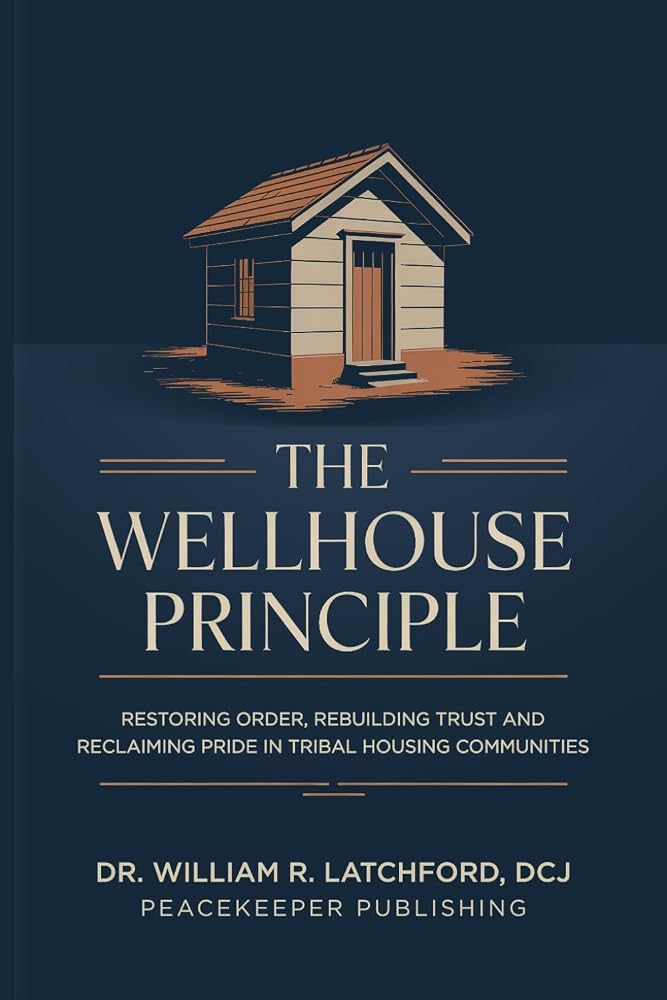
The Wellhouse Principle: Why I Wrote a Leadership Book for Tribal Housing
By Dr. William R. Latchford, DCJ
Every housing community has a wellhouse. It is the small, unremarkable structure that protects the source of everything that flows through the community. Nobody photographs it. Nobody puts it on the brochure. But if it fails, everything downstream fails with it.
That is how I have come to think about housing leadership in Indian Country, and it is why my new book carries that name.
Where the idea came from
I spent more than thirty years in public safety, most of it serving the Seminole Tribe of Florida, rising from Officer to Chief of Police and Executive Director of Public Safety. In that work I partnered constantly with tribal housing professionals: on community safety initiatives, on crisis response, on the slow work of restoring order in neighborhoods that had lost it.
More recently, through the Native Learning Center, I have had the privilege of training tribal housing professionals across the country, including the Southern Plains Indian Housing Association. Those rooms taught me something I could not have learned from the police side alone. The people who manage tribal housing are carrying a load that touches health, safety, dignity, and sovereignty all at once, and most of them have never been handed a leadership framework built for their actual job.
The observation the book is built on
The physical condition of a housing community communicates what is expected, what is acceptable, and what is valued. Residents read that message every day, whether or not anyone intends to send it. A broken gate that stays broken, a maintenance request that disappears, a common area nobody claims: each one tells people what the standard is.
The reverse is also true. When a housing authority sets and holds a visible standard, the community responds. Order is restored, trust is rebuilt, and pride returns. None of that is a maintenance issue. It is a leadership issue.
What the book covers
The Wellhouse Principle draws on environmental psychology, tribal sovereignty, trauma-informed practice, and my own decades in public safety to give housing leaders a practical framework they can use starting tomorrow. It is written for Executive Directors, housing managers, maintenance supervisors, and tribal leaders who know their community deserves better and are ready to lead the effort to get there.
It is not an academic text. It is a field guide, and it is grounded in the realities of NAHASDA funding, tribal governance, and the cultural context that makes tribal housing different from any other housing in the country.
Who it is for
If you run a tribal housing program and you have ever felt that the problems in your community are bigger than your budget, this book is for you. If you supervise a maintenance crew and you sense that the work matters more than anyone acknowledges, it is for you too. And if you sit on a tribal council or board and you want a clearer way to think about what housing leadership should deliver, it was written with you in mind.
Where to find it
The Wellhouse Principle: Restoring Order, Rebuilding Trust, and Reclaiming Pride in Tribal Housing Communities is published by Peacekeeper Publishing, an imprint of Native Peacekeeper Consulting Group, and is available now on Amazon.
If your housing authority would like training built around the framework in the book, NPKCG delivers it on site and through the Native Learning Center webinar series. Request training information →